
A massage gun attachment can make your massage feel either comfortable and useful or sharp and awkward. I see many users pick a random head, press too hard, and wonder why the result feels poor. The better solution is simple: match the attachment shape, contact area, and pressure style to the body part.
To choose the right massage gun attachment, I match the head to the muscle area and the goal. I use a round ball head for general relaxation, a flat head for larger tight muscles, a bullet head for small trigger points, a U-shaped head around the spine or neck area, and a cylinder head for arms, calves, and feet.

Most massage guns come with 4 to 6 heads, but more accessories do not always mean better results. I like to explain it in a simple way: large area, use a wide head; small sore point, use a narrow head; near the spine, use a U-shaped head.
What does each common massage gun attachment do?
A massage gun attachment looks small, but its shape changes the whole massage feeling. If I use the wrong head, the pressure may feel too weak, too sharp, or badly placed. When I use the right one, the vibration feels smoother, safer, and more useful.
The most common massage gun heads include the round ball head, flat head, bullet head, U-shaped fork head, and cylinder head. Each one has a different contact area and pressure depth. I choose the round head for daily use, the flat head for larger stiff muscles, the bullet head for trigger points, and the U-shaped head for areas near the spine.
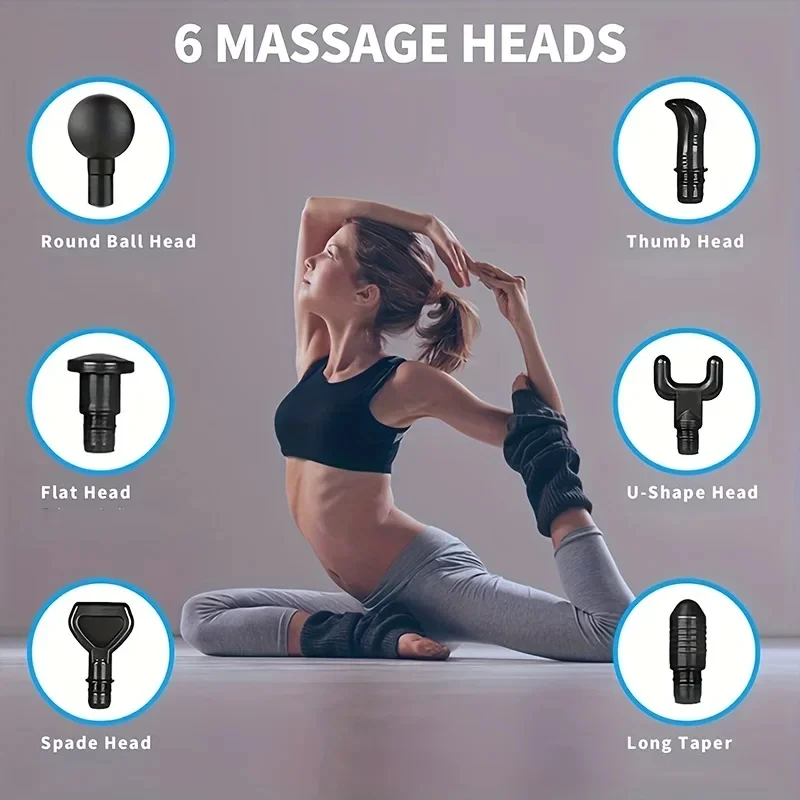
Round ball head: the easy daily choice
The round ball head is usually the most beginner-friendly massage gun attachment. I use it when I want a soft, even, and comfortable massage. Its contact area is wide and smooth, so the vibration spreads across the muscle instead of hitting one tiny point.
It works well on:
- Thighs
- Calves
- Glutes
- Shoulders
- Upper back
- General body relaxation
I usually recommend this head for daily fatigue, light warm-up before exercise, and gentle muscle relief after work. For home users, it is often the safest starting point because it does not feel too aggressive.
Flat head: stronger pressure for bigger muscles
The flat head has a broad and firm surface. I use it when a large muscle feels tight or heavy. Compared with the round head, it gives a stronger and more direct feeling. It can help users work on large stiff areas without using a sharp point.
It is commonly used on:
- Chest muscles
- Lower back muscles
- Quadriceps
- Upper back
- Hamstrings
I prefer the flat head after intense training, but I always keep the pressure controlled. Stronger does not mean better. If the skin turns red quickly or the area feels painful, I reduce the speed or change the attachment.
Bullet head: precise but easy to overuse
The bullet head has a small contact point. It delivers focused pressure to one exact spot. I use it only for small areas, such as tight knots or local soreness points.
It can be useful for:
- Forearm tension
- Calf knots
- Small muscle trigger points
- Local tight areas around larger muscles
However, I never use the bullet head on bones, joints, the spine, the front of the neck, or the abdomen. This head can feel very intense. I also avoid staying on one point for too long.
U-shaped fork head: better for both sides of the spine
The U-shaped head has a hollow center. This shape helps avoid direct pressure on the spine while touching the muscles on both sides. I often see office workers and students like this attachment because it feels targeted around the neck, trapezius, and back line.
It is often used for:
- Neck muscles beside the cervical spine
- Trapezius
- Muscles along both sides of the spine
- Shoulder-neck fatigue from sitting
I still use it carefully. The U-shape does not mean the neck area is risk-free. I keep the speed low and avoid the front of the neck.
Cylinder head: good for long muscle lines
The cylinder head has a longer, narrower shape. I use it when I want to move along muscles like rolling by hand. It works well on arms, calves, and feet because those areas often have long muscle lines.
It is useful for:
- Arms
- Calves
- Soles of the feet
- Narrow muscle strips
- Limb stiffness
Here is a simple comparison table I use when helping buyers or users understand massage gun heads:
| Massage gun head | Pressure feeling | Best use area | Good for beginners? |
|---|---|---|---|
| Round ball head | Soft to medium | Large muscles, full body | Yes |
| Flat head | Medium to strong | Big stiff muscles | Yes, with care |
| Bullet head | Strong and focused | Small knots, trigger points | Use carefully |
| U-shaped head | Medium, guided | Neck-side and spine-side muscles | Yes, at low speed |
| Cylinder head | Medium, rolling feel | Arms, calves, feet | Yes |
From my experience, most users do not need many special attachments at first. A good set with round, flat, bullet, U-shaped, and cylinder heads already covers most daily recovery needs.
How should I choose a massage gun attachment for each body part?
A massage gun attachment should follow the body part, not just personal preference. Some areas have thick muscles, while others are close to bones, joints, nerves, or softer tissue. If I choose only by “which head feels strongest,” I may create discomfort instead of relief.
I choose the attachment by asking one simple question: Is this area large, small, bony, or sensitive? Large muscle groups usually need a round or flat head. Small tight points may need a bullet head for a short time. Areas near the spine should use a U-shaped head carefully, and long limb muscles can use a cylinder head.
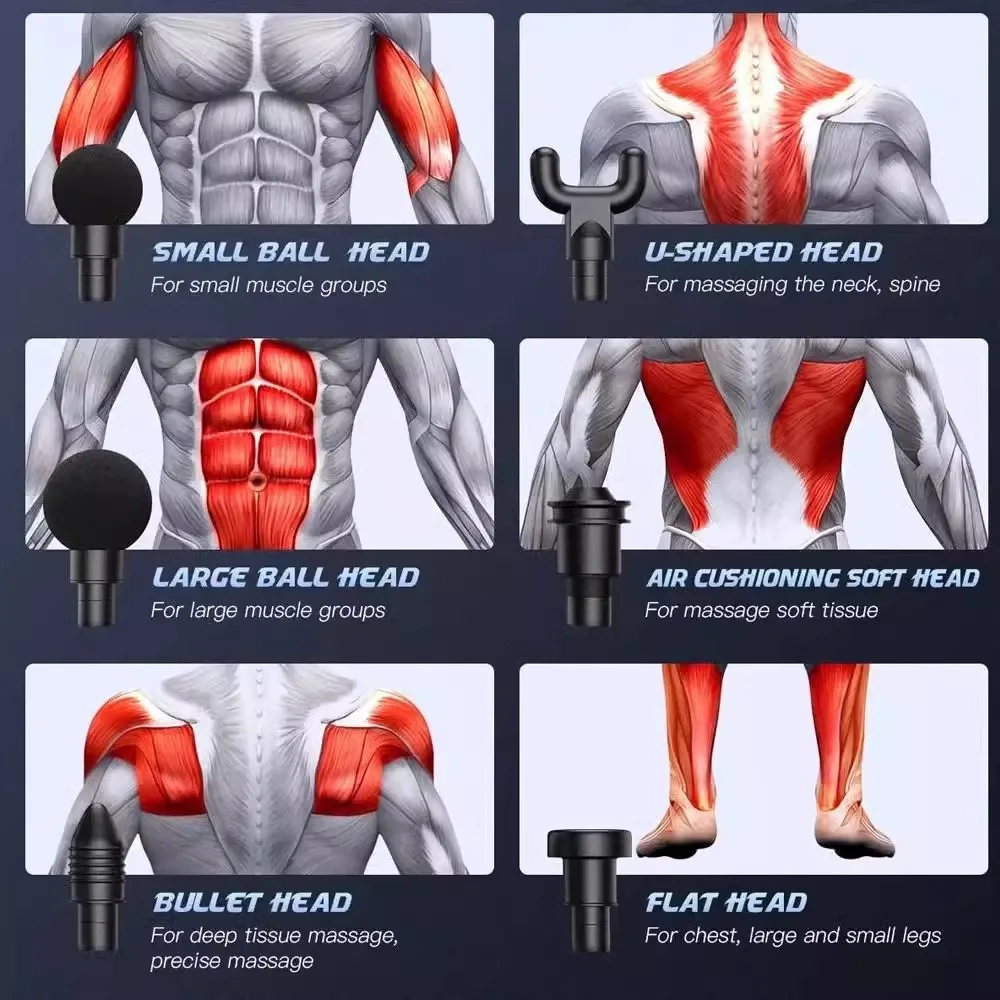
Neck and cervical area
For the neck and cervical area, I usually choose the U-shaped fork head. The reason is simple. The center gap helps avoid direct impact on the spine, while the two sides contact the muscles beside it.
I avoid using the bullet head here because the pressure is too focused. I also avoid the front of the neck because that area contains sensitive structures. If a user has neck pain, numbness, dizziness, or a medical condition, I would tell them to ask a qualified professional before using any massage gun.
A simple neck rule I follow is:
Use low speed, light pressure, short time, and avoid bones.
Shoulders and upper back
For shoulders and upper back, I choose based on the goal. If the user wants daily relaxation, I use the round ball head. If the muscle feels very stiff after sports or heavy work, I may use the flat head for deeper and broader pressure.
The upper trapezius often becomes tight after long screen time. I move slowly and do not press down hard. The massage gun should glide across the muscle. It should not feel like I am drilling into the shoulder.
Glutes, thighs, and large leg muscles
The glutes, quadriceps, hamstrings, and calves usually handle more pressure because they are large muscle groups. I often start with the round ball head to warm up the area. Then I may switch to the flat head if the user wants deeper relaxation.
For calves, I sometimes use the cylinder head because it follows the long shape of the muscle. I keep moving in one direction, then move to the next line. I avoid the back of the knee because that area is sensitive.
Forearms, calves, and feet
For the forearms, calves, and soles, the cylinder head can feel natural. It gives a rolling-style massage and works well on narrow areas. I also use the round head when the user wants a softer touch.
For the soles, I keep the speed moderate. Some users like strong foot massage, but I still avoid sharp pressure around bony points. Comfort matters more than intensity.
Local knots and sore points
For local muscle knots, I use the bullet massage gun attachment only for short, controlled sessions. It is best for pinpoint work. It is not best for general massage.
I follow this simple timing rule:
- Start with a round or flat head for general warm-up.
- Use the bullet head on the sore point for 30 to 60 seconds.
- Stop if the pain feels sharp, electric, or strange.
- Return to a wider head to relax the area again.
Here is a quick body-part guide:
| Body area | Best attachment | Why I choose it |
|---|---|---|
| Neck-side muscles | U-shaped head | It avoids direct spine pressure |
| Shoulders | Round or flat head | It covers medium to large muscles |
| Upper back | Round or flat head | It gives broad muscle relaxation |
| Lower back muscles | Flat or round head | It works on large tight areas |
| Thighs | Round or flat head | It covers big muscle groups |
| Calves | Round or cylinder head | It follows the muscle line |
| Forearms | Cylinder or bullet head | It targets narrow muscle areas |
| Soles | Cylinder or round head | It feels controlled and steady |
| Small knots | Bullet head | It gives precise pressure |
When I explain this to B2B buyers, I also remind them that clear user instructions matter. A massage gun may have good power and good battery life, but if the attachment guide is confusing, end users may misuse it. For brands and distributors, a simple printed guide or QR-code video can reduce after-sales questions.
How can I choose a massage gun attachment based on my daily need?
A massage gun attachment should fit the way I actually use the device. A gym user, an office worker, and a family buyer do not need the same routine. If I choose only by the product photo, I may buy more accessories than I need and still miss the useful ones.
I choose based on the main use case. Office users usually need a U-shaped head and round head for shoulder-neck comfort. Fitness users often need a flat head and bullet head for deeper muscle recovery. Families should focus on soft, easy attachments like the round ball head and flat head for simple daily care.

For office workers
I often hear office users say, “My neck and shoulders feel tight after a full day at the computer.” For this group, I recommend a simple pair:
- U-shaped head for muscles beside the neck and spine
- Round ball head for shoulders, upper back, and general relaxation
The goal is not aggressive deep massage. The goal is to relax stiff muscles caused by long sitting, screen time, and poor posture. I prefer low to medium speed for this group.
A simple office routine may look like this:
- Use the round head on the shoulders for 60 seconds per side.
- Use the U-shaped head beside the upper spine for 30 to 60 seconds.
- Use the round head again on the upper back.
- Stop before the area feels sore or overheated.
For fitness and sports users
Fitness users usually want deeper muscle recovery after training. For them, I like the combination of:
- Flat head for large sore muscles
- Bullet head for small tight points
- Round head for warm-up and finish
After leg day, for example, I may start with the round head on the thighs. Then I switch to the flat head for the quadriceps and glutes. If one small knot remains, I use the bullet head for a short time.
I avoid claiming that a massage gun can “cure” injuries. It is a recovery tool, not a medical device. If pain is sharp, swollen, or linked to injury, I would always suggest professional evaluation.
For family use
For families, I prefer simple and gentle options. A family device may be used by adults, older teens, and different body types. I usually suggest:
- Round ball head as the main daily head
- Flat head for larger stiff muscles
- U-shaped head if shoulder-neck use is common
I would not make the bullet head the main selling point for family users because it needs more caution. It is useful, but it is easier to misuse.
For users with specific discomfort points
Some users buy a massage gun because one area always feels tight. In that case, the attachment choice should be more targeted.
| User need | Better attachment choice | Simple reason |
|---|---|---|
| Long sitting shoulder tightness | U-shaped + round head | Safer around neck-side muscles |
| Post-workout thigh soreness | Flat + round head | Covers large muscle areas |
| Local calf knot | Bullet + round head | Pinpoint plus general relaxation |
| Arm fatigue | Cylinder + round head | Follows narrow muscle lines |
| Family daily relaxation | Round + flat head | Easy and low irritation |
What I look at as a B2B supplier
At CHALKART, we work with B2B buyers who sell massage products in Europe, including markets such as Germany and Poland. When I discuss massage gun accessories with procurement managers, I do not only talk about shape. I also look at product matching and after-sales risk.
For wholesale buyers, I suggest checking:
- Attachment fit: The head should lock firmly into the massage gun body.
- Material feel: EVA foam, silicone, or hard plastic should match the user group.
- Surface finish: The head should be smooth, with no sharp edges or bad seams.
- Noise and vibration: A loose attachment can create extra noise.
- Packaging guide: The box should explain each head in simple language.
- MOQ flexibility: Smaller trial orders can help test market response.
- After-sales support: Replacement heads should be available.
I always tell buyers to verify certificates, test samples, and review actual product performance before placing larger orders. Certifications are useful documents, but buyers should still check whether the final product matches their market requirements.
What safety rules should I follow when using a massage gun attachment?
A massage gun attachment can feel safe because it is small, but wrong use can still cause redness, bruising, or discomfort. The biggest problem I see is staying too long on one point or using a sharp head on a sensitive area. That mistake can turn recovery into irritation.
The key safety rule is simple: use the correct head, keep moving, and limit each spot to 30 to 60 seconds. I avoid bones, joints, the spine, the front of the neck, the abdomen, and fragile tissue. I use lower speed on sensitive areas and stop if the feeling becomes sharp, numb, or painful.
Do not use the bullet head on risky areas
The bullet head is the most precise massage gun attachment, but it is also the easiest to misuse. I never recommend using it on:
- Bones
- Joints
- Spine
- Front of the neck
- Carotid artery area
- Abdomen
- Thin or fragile skin
- Bruised or swollen tissue
The bullet head can be helpful for a calf knot or forearm tightness, but it should not be used like a general massage head. I keep the time short and the pressure light.
Do not use strong flat-head pressure on fragile areas
The flat head feels stable, but it can deliver strong pressure. I avoid using it with high force on the face, front neck, or any fragile skin area. I also avoid using it directly on joints.
A good massage should feel like pressure on muscle, not impact on bone. If the user feels bone vibration, I change the angle, reduce the pressure, or switch to a softer head.
Keep each point short
I use a simple time rule: 30 to 60 seconds per single area. I do not hold the massage gun on one exact point for several minutes. Long fixed pressure may cause skin redness, soreness, or bruising.
For a larger body part, I divide the muscle into zones. For example, on the thigh, I may work on the upper, middle, and lower areas separately. I move slowly, but I keep moving.
Start low and increase only if needed
Many users turn the speed to the highest level first. I do the opposite. I start at a lower speed and increase only if the body feels comfortable.
A safe routine usually follows this order:
- Start with a wide head, such as the round ball head.
- Use low or medium speed for the first minute.
- Move across the muscle, not directly into bone.
- Add a flat or bullet head only if needed.
- Stop if the feeling becomes sharp, numb, or unusual.
Know when not to use it
A massage gun is not suitable for every situation. I would avoid using it on areas with:
- Recent injury
- Swelling
- Open wounds
- Skin infection
- Severe varicose veins
- Unexplained pain
- Numbness or nerve symptoms
- Medical implants near the area
If a user has a medical condition, pregnancy, circulation problems, or serious pain, I would suggest asking a doctor, physiotherapist, or qualified health professional before using a massage gun.
Why safety guidance matters for brands
For B2B buyers, safety is not only a user issue. It is also a product quality and after-sales issue. If the instruction manual is unclear, users may blame the product when they actually used the wrong attachment.
When I help buyers evaluate a massage gun set, I look for:
| Safety item | What I check | Why it matters |
|---|---|---|
| Attachment guide | Clear body-part instructions | It reduces misuse |
| Warning label | Risky areas are listed | It protects users |
| Material quality | Smooth and skin-safe surface | It improves comfort |
| Locking design | Head does not loosen | It reduces noise and risk |
| Speed control | Low-speed option exists | It helps sensitive users |
| After-sales parts | Spare heads are available | It supports long-term use |
I believe the best massage gun attachment set is not the one with the most unusual shapes. It is the one that users understand quickly and use safely.
Frequently Asked Questions
What is the best massage gun attachment for beginners?
The round ball head is usually the best attachment for beginners. It has a wide contact area, soft pressure, and low irritation. I recommend starting with it on large muscles such as thighs, calves, glutes, shoulders, and upper back before trying stronger heads.
Can I use a bullet massage gun attachment on my neck?
I do not recommend using a bullet head on the neck. The pressure is too focused, and the neck has sensitive structures. I prefer a U-shaped head on the muscles beside the spine, with low speed and light pressure. I avoid the front of the neck completely.
How long should I use one massage gun attachment on one area?
I usually limit one spot to 30 to 60 seconds. For large muscles, I move across different zones instead of staying fixed on one point. If the area becomes red, painful, numb, or uncomfortable, I stop and change the setting or attachment.
Which massage gun attachment is best for sore legs after exercise?
For sore legs after exercise, I usually start with the round ball head for general relaxation. Then I use the flat head on larger muscles like thighs and glutes. For calves, I may use the cylinder head. I only use the bullet head briefly on small tight knots.
Do more massage gun attachments mean a better product?
More attachments do not always mean a better product. I care more about practical shapes, safe materials, firm fit, clear instructions, and replacement availability. For most users, 4 to 6 well-designed heads are enough for daily massage and post-workout recovery.
Conclusion
The right massage gun attachment depends on your body part, comfort level, and daily use. I use the round head for general relaxation, the flat head for larger stiff muscles, the bullet head for short trigger-point work, the U-shaped head near the spine, and the cylinder head for arms, calves, and feet. If you are sourcing massage guns for your brand, contact CHALKART to discuss flexible MOQ, attachment options, sample testing, and after-sales support.


