
China Exports TOP 5 OEM Neck And Shoulder Massager Models: Which Should Buyers Compare?
OEM Neck And Shoulder Massager sourcing looks simple until buyers compare real samples, safety reports, noise levels, packaging quality, and after-sales risk. A poor choice can create returns, platform complaints, or customs problems. I usually advise buyers to start with the five main export models and match each one to its channel, market, and compliance needs.
China exports five major OEM neck and shoulder massager categories: car and home massage pillows, wearable U-shaped travel neck pillows, traction-stretch 3-in-1 neck pillows, bionic kneading shoulder massagers, and EMS pulse plus far-infrared heating shawls. Each model fits different markets, price points, and procurement risk levels.
China has become a major manufacturing base for shoulder and neck massage products because the supply chain is mature, mold options are broad, and OEM/ODM customization is flexible.[^1] Below, I will break down the five high-volume export models from a buyer’s view, not from a consumer hype angle.
Why Is The Car And Home OEM Neck And Shoulder Massager Pillow Still A High-Volume Export Model?
The car and home massage pillow remains one of China’s most stable neck and shoulder massager export categories because it has mature tooling, established components, and broad usage scenarios. It suits wholesalers, car accessory stores, supermarkets, gift buyers, and cross-border sellers who need reliable, price-sensitive volume.

What this model usually includes
This product is often a compact, curved massage cushion with rotating kneading heads and a heating function. Most versions support use on the neck, shoulders, back, waist, thighs, and calves. The same item can be sold as a car massage pillow, home massage cushion, office relaxation device, or holiday gift.
Common configurations include:
- Rotating kneading massage heads
- Warm heat function
- AC home adapter
- Car power cable
- Breathable mesh fabric or PU leather
- Removable washable cover
- Optional wireless version for upgraded lines
In my experience, this model is often the first sample that general importers request. It is easy to understand, easy to present in a catalog, and easy to adapt for multiple retail channels.
OEM customization options
For an OEM neck and shoulder massager pillow, buyers usually customize:
| OEM Item | Common Options | Procurement Note |
|---|---|---|
| Logo | Silk print, woven label, heat transfer | Confirm durability after rubbing tests |
| Fabric | Mesh, PU leather, short plush | Check smell, abrasion, and cleaning method |
| Power | EU, US, UK, AU plugs; car cable | Verify target-market electrical requirements |
| Packaging | Color box, gift box, mailer box | E-commerce packaging needs drop-test review |
Best-fit markets and channels
This basic massage pillow works well in:
- Middle East
- Southeast Asia
- Eastern Europe
- Latin America
- Automotive accessory shops
- Supermarket shelves
- Corporate gifts
- Cross-border marketplace “general goods” categories
The product has strong versatility, but that also creates strong competition. Many suppliers can offer similar-looking units. Buyers should avoid choosing only by FOB price. A very low quote may reflect cheaper motors, poor heat control, thinner fabric, or weak adapters.
Key quality checks for buyers
I would focus on these tests during supplier evaluation:
-
Motor life test
Ask the factory how long the motor has been aged during internal testing. For high-volume retail orders, a longer continuous aging test gives buyers more confidence. -
Adapter and EMC documents
Electrical safety and electromagnetic compatibility documents should be reviewed before bulk production.[^2] Certifications should be treated as documents to verify, not as marketing decorations. -
Noise level
A pillow that feels acceptable in a noisy sample room may sound too loud at home. Buyers should test it in a quiet room. -
Packaging strength
If the product goes to Amazon, TikTok Shop, Mercado Libre, or independent websites, shipping damage can create high return rates.[^3]
This model is not the most fashionable, but it remains one of the safest starting points for volume orders. For buyers building a private-label massage product line, it can work as the entry-level SKU while more differentiated items sit above it.
Why Is The Wearable U-Shaped OEM Neck And Shoulder Massager Popular For Travel And Office Channels?
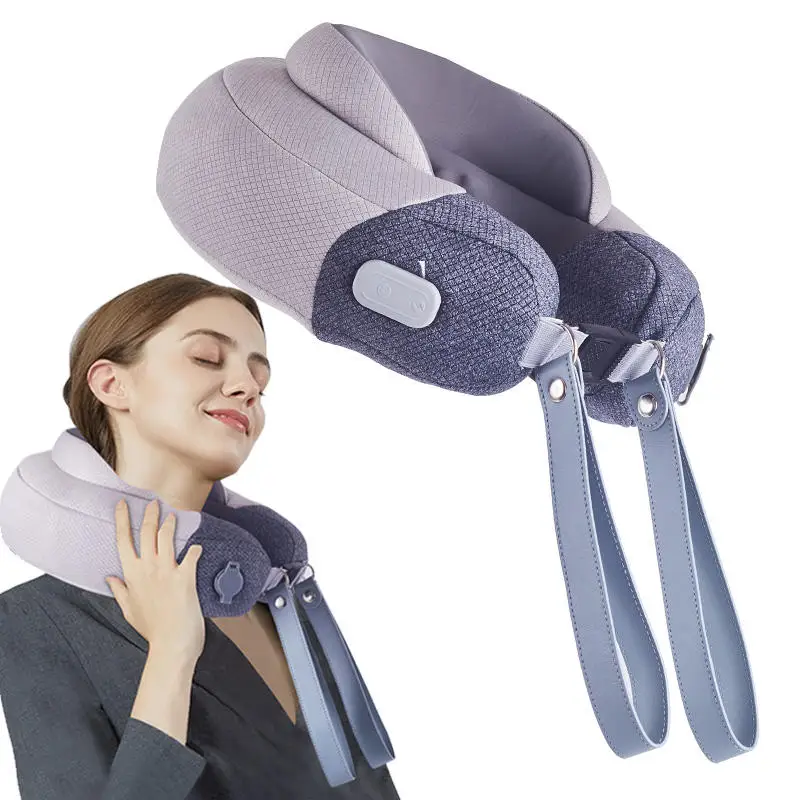
The wearable U-shaped OEM Neck And Shoulder Massager combines physical neck support with electric massage, heat, or vibration. It is best for travel brands, office wellness buyers, airport gift stores, DTC sellers, and importers targeting North America, Western Europe, Japan, South Korea, and Australia.
Why buyers like this model
A U-shaped travel neck massager usually has an ergonomic pillow body with memory foam inside. Some models include air-inflation support, while others focus on soft fabric and compact storage. Most current versions are USB rechargeable and wireless, which fits airplane, train, office, and commuting use.
Typical features include:
- U-shaped ergonomic structure
- Memory foam neck support
- Optional inflatable support chamber
- Kneading or vibration massage module
- Constant-temperature heating
- USB charging
- Foldable storage design
- Travel pouch or full travel gift set
I once reviewed a sample that looked excellent in photos but felt too hard after 15 minutes of wearing. That reminded me of a simple truth: for wearable massage products, comfort is a product specification, not just a feeling.
Procurement focus: comfort comes first
For this type of neck massage pillow, buyers should test real wearing comfort before confirming a large order. A spec sheet cannot fully show pressure distribution, fabric touch, or neck angle.
Important sample tests include:
- Neck support height check
- Memory foam rebound test
- Fabric softness and breathability review
- Charging safety test
- Battery runtime test
- Button position and usability test
- Storage bag fit test
Market positioning
This product is usually positioned above the basic wired massage pillow. It can sell as a travel wellness product, office relaxation product, or premium gift item. It works especially well for:
| Channel | Buyer Priority | Suggested Customization |
|---|---|---|
| DTC brand | Differentiation and photos | Fabric, color, packaging, travel pouch |
| Airport gift shop | Compact giftability | Premium box, multilingual manual |
| Office wellness buyer | Comfort and safety | Soft fabric, simple controls |
| Travel goods importer | Portability | Foldable design, carrying bag |
| E-commerce seller | Conversion rate | Lifestyle packaging and clear features |
Compliance and claim control
Buyers should be careful with wording. This product should not be promoted as correcting cervical spine problems or treating medical conditions.[^4] Safer wording includes:
- Helps relax neck muscles
- Supports the neck during travel
- Provides warm comfort
- Helps relieve everyday fatigue
- Suitable for office breaks and travel rest
OEM opportunities
Common OEM options include:
- Memory foam hardness
- Massage mode settings
- Heating temperature range
- Short plush or knitted fabric
- Color matching
- Logo embroidery
- Travel pouch
- Full travel set packaging
This model is not the cheapest, but it has strong value for developed markets. If the buyer’s customer base cares about portability, aesthetics, and comfort, a wearable U-shaped design can create better brand recognition than a generic pillow.
Why Is The Traction-Stretch 3-In-1 OEM Neck And Shoulder Massager A 2026 Growth Model?
The traction-stretch 3-in-1 OEM Neck And Shoulder Massager is a growth model for 2026 planning because it combines physical neck support, targeted kneading, and heat. It fits health gift channels, online independent stores, pharmacy-adjacent buyers, and premium e-commerce brands that want stronger product differentiation.

What makes this product different?
This model is usually designed as an ergonomic neck pillow with a separated support structure. The shape supports the neck while the massage module targets specific areas.
Main functions often include:
- Physical neck support
- Targeted kneading massage
- Warm heating function
Why it matters for private-label buyers
A standard massager competes mainly on price. A traction-stretch neck pillow can compete on structure, user experience, and perceived care value. That makes it more suitable for brand owners who sell through:
- Shopify stores
- Amazon premium listings
- Health gift catalogs
- Wellness product bundles
- Office employee benefit programs
However, buyers should be extra careful with claims. The product may provide physical support and relaxation, but marketing materials should avoid saying it treats cervical disease, corrects spinal conditions, or replaces medical care.
OEM customization areas
| Customization Area | Options | Buyer Evaluation Point |
|---|---|---|
| Pillow contour | Higher support, lower support, wider contact | Test with real users |
| Support hardness | Soft, medium, firm | Check long-term compression deformation |
| Heat settings | One-level or multi-level heat | Confirm temperature protection |
| Massage logic | Kneading rhythm, timer, intensity | Avoid uncomfortable pressure |
| Fabric | Skin-friendly knit, breathable fabric | Confirm material safety |
| Branding | Logo print or embroidery | Check colorfastness |
| Packaging | Gift box, e-commerce box, health channel box | Control claims carefully |
Quality control priorities
The core risk is not only the motor. The support structure is also critical. If the pillow deforms after repeated pressure, the user experience drops quickly.[^5]
Buyers should request or arrange:
- Compression deformation testing
- Long-duration pressure testing
- Heat cycle testing
- Fabric and filling material safety checks
- Cable and USB power stability review
At CHALKART, we have seen buyers become more interested in this type of product because it gives them more story to tell. The story should still be restrained. I prefer wording like “designed for neck support and daily relaxation” instead of aggressive treatment language.
Why Does The Bionic Kneading Shoulder Massager Work Well For Family Gift Orders?
The bionic kneading shoulder massager is popular for family gift orders because it covers the neck, shoulders, trapezius area, and upper back with stronger mechanical massage. Many models combine kneading, tapping, and heat, which makes them attractive for holiday retail, home goods wholesalers, and department store channels.

Product structure and use cases
This model is usually a shoulder-wrapped massage shawl. It has a wider body than a small massage pillow and often uses hand straps or arm loops so users can adjust pressure manually. Some upgraded versions use dual motors to support both kneading and tapping actions.
Common configurations include:
- Bionic kneading massage module
- High-frequency tapping motor
- Heating function
- Wider shoulder and upper-back coverage
- Simple control panel
- Wired power supply for bulk orders
- Optional rechargeable wireless version
This product is especially suitable for older family users because the operation can be simple and the massage feeling is direct. Buyers should still test intensity carefully. Too strong does not always mean better.
Best channels
The bionic shoulder massager fits:
- Home goods wholesalers
- Holiday gift importers
- Department stores
- Offline retail chains
- TV shopping
- E-commerce gift campaigns
- Fitness and wellness distributors
It performs well during holiday seasons because it has high gift value. The box is larger than a travel neck pillow, so buyers should calculate freight, warehouse space, and carton quantity early.
Key procurement risks
The dual-motor design can create strong user value, but it also increases quality-control requirements. Buyers should pay attention to:
| Risk Area | What Can Go Wrong | How Buyers Can Check |
|---|---|---|
| Motor assembly | Noise, vibration, early failure | Long aging test and sample teardown |
| Gear structure | Clicking sound or jamming | Continuous cycle testing |
| Heat module | Uneven heating or overheating | Temperature mapping |
| Fabric | Pilling, odor, weak stitching | Material inspection and rub test |
| Control panel | Confusing operation | User test with non-technical users |
| Packaging | Damage in transit | Drop test and carton strength review |
Noise matters more than many buyers think
Noise level directly affects reviews.[^6] A customer may accept a strong massage, but a loud mechanical sound can make the product feel cheap. I recommend buyers test samples in a normal living room, not only in a busy trade show booth or factory office.
Useful checks include:
- Noise level at low and high intensity
- Noise change after 30 minutes of use
- Motor temperature after repeated cycles
- Gear sound under pressure
- Stitching condition after strap pulling
OEM customization options
Buyers can customize:
- Battery capacity for wireless versions
- Fabric texture
- Button layout
- Shell color
- Logo position
- Color box and gift packaging
For large gift orders, packaging design can strongly affect sell-through. A good package should explain the product clearly without overpromising. Buyers should avoid medical-style graphics unless the product and claims meet the target market’s regulatory requirements.
This model has strong mass-market value. It is not as compact as a travel pillow, and it is not as professional as an EMS shawl. However, it offers a powerful balance of function, gift appeal, and familiar consumer understanding.
Why Is The Far-Infrared OEM Neck And Shoulder Massager Better For Professional Health Channels?
The far-infrared OEM Neck And Shoulder Massager is better for professional health channels because it uses electrical large-area heating instead of heavy mechanical motors. It suits pharmacies, wellness brands, health product wholesalers, and importers who can manage stricter compliance requirements.

How this model works
This type of product is usually made with flexible fabric. It contains multiple electrode pads and a large heating area from the shoulders to the upper back. EMS pulse modes provide different stimulation patterns, while far-infrared or large-area heating provides warm comfort.
Typical features include:
- Flexible wearable fabric
- Adjustable intensity levels
- Large heating zone
- NTC temperature control
- Overheat protection
- USB charging
- Foldable lightweight body
- No heavy mechanical massage motor
Because the product does not rely on bulky motors, it can be lighter than a traditional kneading shoulder massager. This makes it easier to store, ship, and wear.
Why compliance is the main buying issue
This category can cross into regulated territory more easily than a basic relaxation massager.[^7] If a buyer uses words like “therapy,” “treatment,” “cervical disease,” or “pain cure” without proper regulatory basis, the risk increases. Products may face platform removal, customs delay, recall, or legal complaints.
Safer commercial wording may include:
- Helps relax muscles
- Provides warm comfort
- Supports daily relaxation
- Helps reduce everyday fatigue
- Designed for shoulder and neck wellness routines
Buyers should confirm the correct regulatory classification in the target market. For application-specific decisions, they should consult qualified compliance professionals or testing labs.
Documents buyers should verify
For heating products, buyers should not rely only on a supplier’s verbal promise. They should request and verify relevant documents for the target market.
Possible document areas include:
| Area | Why It Matters |
|---|---|
| Electrical safety | Reduces risk of shock or unsafe charging |
| EMC testing | Supports market entry and platform review |
| Battery safety | Important for rechargeable products and transport |
| Material safety | Important for skin-contact fabric |
| Temperature control test | Reduces overheating and burn risk |
| Label and manual review | Controls claim and compliance risk |
| Factory audit documents | Helps evaluate supplier management systems |
CHALKART’s factory has passed BSCI audit, and I still tell buyers to verify all audit and test documents during procurement. A factory audit is useful, but it does not replace product-level testing for the exact model and target market.
OEM customization options
For this professional-style massager, OEM/ODM options may include:
- Intensity level design
- Heating area size
- Electrode layout
- Fabric selection
- Control panel style
- Pharmacy-channel packaging
- Private-label manual
- Brand color system
- Accessory pouch or charging cable set
Where it fits best
This model is not always the best choice for low-price general wholesale. It is better for buyers who understand compliance and can manage a more careful marketing strategy.
It fits:
- Western Europe
- Japan and South Korea
- North America
- Pharmacy importers
- Health and wellness brands
- Professional health product wholesalers
- Premium online stores
The key advantage is differentiation. The key risk is claim control. Buyers should build this product slowly, confirm documents early, and review all packaging language before mass production.
How Should Buyers Match China OEM Neck And Shoulder Massager Models To Regional Markets?
A product that sells well in one region may fail in another. Buyers often lose money when they copy a hot-selling model without checking local consumer preference, plug standards, packaging expectations, and compliance documents. Regional matching is a practical sourcing step, not just a marketing exercise.
Buyers should match each China OEM neck and shoulder massager model to the target region, channel, and price level. Europe and North America prefer lighter wireless products and strong compliance documents. Japan and South Korea value detail and wellness functions. Southeast Asia, the Middle East, and Latin America often prefer durable basic models.
Regional preference table
| Region | Common Preference | Better-Fit Models | Buyer Focus |
|---|---|---|---|
| Europe | Compliance, design, low noise | U-shaped pillow, 3-in-1 traction pillow, EMS shawl | CE, EMC, RoHS, manual claims |
| North America | Wireless, giftable, online reviews | U-shaped pillow, bionic shoulder massager, 3-in-1 pillow | Battery safety, packaging, return rate |
| Japan & South Korea | Detail, compact design, wellness features | U-shaped pillow, EMS shawl, refined shoulder massager | Finish, noise, fabric, claim control |
| Middle East | Stable performance, gift packaging | Massage pillow, bionic shoulder massager | Adapter quality, durability |
| Southeast Asia | Price-performance balance | Massage pillow, shoulder massager | Heat safety, stable supply |
| Latin America | Durable basics and strong value | Car/home pillow, wired shoulder massager | Plug options, Spanish/Portuguese manuals |
How I suggest buyers build a product matrix
A balanced OEM massage product line should not rely on one SKU. I usually recommend three levels:
-
Entry-level volume SKU
Use a mature car and home massage pillow. It gives stable price and broad channel use. -
Mid-level differentiated SKU
Use a U-shaped travel neck pillow or 3-in-1 support pillow. It gives better branding space and stronger online storytelling. -
Premium or professional SKU
Use a bionic shoulder massager or EMS heating shawl. It gives higher perceived value but needs stronger QC and compliance review.
Supplier evaluation checklist
Before confirming a China supplier, buyers should check:
- Factory experience with massage products
- OEM/ODM engineering capability
- Sample development speed
- Mold ownership or access
- Motor and heating module sourcing
- Incoming material inspection
- Aging test process
- Packaging drop test process
- Export market experience
- BSCI or other audit documents, if relevant
- Product-level safety reports
- Manual and label review support
At CHALKART, our experience is that many buyers do not fail because they picked the wrong product category. They fail because they skipped small details before mass production. A logo position, weak carton, noisy motor, or unclear manual can become a real cost after shipment.
Questions buyers should ask suppliers
Before placing an OEM order, buyers can ask:
“Can you provide the latest test reports for this exact model and configuration?”
“What parts can be customized without changing tooling?”
“How many hours do you run aging tests before shipment?”
“Can we test different fabrics and massage intensities before order confirmation?”
“Can your team help review the manual to avoid medical claims?”
These questions help separate a real manufacturing partner from a simple trader. They also help buyers reduce hidden risk before paying for large production.
Frequently Asked Questions
What is the best OEM Neck And Shoulder Massager model for first-time importers?
A car and home massage pillow is often the best starting model because the mold is mature, the price is manageable, and the application is broad. Buyers should still verify motor durability, heating safety, adapter quality, packaging strength, and target-market compliance documents before bulk ordering.
Which neck and shoulder massager is best for Europe and North America?
Wireless U-shaped travel neck pillows, 3-in-1 traction-style pillows, and refined shoulder massagers often fit Europe and North America well. These markets usually require stronger compliance documents, better packaging, lower noise, and careful claims. Buyers should verify CE, EMC, battery, and material-related documents when applicable.
Can I customize logo, color, packaging, and functions for OEM orders?
Yes. Most China OEM neck and shoulder massager factories can customize logos, colors, fabrics, manuals, packaging, massage modes, heating settings, and accessories. The exact options depend on tooling, MOQ, component availability, and safety requirements. Buyers should confirm all changes through approved pre-production samples.
Are EMS pulse neck and shoulder massagers regulated products?
They may face stricter regulatory review depending on market classification, claims, and technical design. Buyers should avoid unverified medical or treatment claims. They should consult qualified compliance professionals and confirm product testing, labeling, manuals, and advertising language before importing or selling EMS-related products.
How can buyers reduce return rates for massage products?
Buyers can reduce returns by testing real user comfort, motor noise, heating temperature, battery runtime, packaging strength, and manual clarity before mass production. They should also choose the right model for the target channel and avoid exaggerated product claims that create unrealistic consumer expectations.
[^1]: "Due diligence in electronics and vehicle manufacturing", https://www.oecd.org/en/publications/2025/07/responsible-business-conduct-spotlights_f7f722d0/due-diligence-in-electronics-and-vehicle-manufacturing_82c76c55.html. International manufacturing and trade statistics identify China as a leading producer and exporter of electrical and consumer-appliance goods, which provides contextual support for describing China as a major OEM manufacturing base for neck and shoulder massagers. Evidence role: general_support; source type: institution. Supports: China’s large role in global electrical-appliance manufacturing and exports, providing context for its position as an OEM/ODM base for massage products.. Scope note: Such data would support the broader manufacturing context, not prove the maturity of every individual massager supplier or mold ecosystem. [^2]: "Equipment Authorization", https://www.fcc.gov/engineering-technology/laboratory-division/general/equipment-authorization. Government conformity-assessment guidance for electrical and electronic products explains that safety and electromagnetic-compatibility evidence forms part of the technical documentation required before products are placed on the market, supporting the need to review these documents before bulk production. Evidence role: expert_consensus; source type: government. Supports: Official guidance requires or expects technical documentation and conformity evidence for electrical safety and electromagnetic compatibility before placing products on regulated markets.. [^3]: "How much a damaged pack can really cost your business", https://www.amcor.com/insights/blogs/how-much-a-damaged-pack-can-really-cost-your-business. Research on e-commerce logistics and parcel packaging identifies product damage in transit as a contributor to returns and customer dissatisfaction, supporting the article’s emphasis on packaging strength for online sales channels. Evidence role: general_support; source type: research. Supports: Transit damage is a recognized contributor to e-commerce returns and packaging testing is used to reduce parcel-delivery damage.. Scope note: The source would support the general relationship between shipping damage and returns, not return rates for these named platforms or for neck massagers specifically. [^4]: "General Wellness: Policy for Low Risk Devices - Guidance", https://www.fda.gov/regulatory-information/search-fda-guidance-documents/general-wellness-policy-low-risk-devices. Regulatory guidance on intended use states that products marketed to diagnose, cure, mitigate, treat, or prevent disease may be regulated as medical devices or subject to health-claim substantiation requirements, supporting the caution against cervical-spine treatment claims for a consumer neck massager. Evidence role: definition; source type: government. Supports: Products promoted for treating, correcting, or mitigating medical conditions may fall under medical-device or health-claim rules.. [^5]: "Bio-Inspired Microstructural Engineering of Polyurethane ...", https://pmc.ncbi.nlm.nih.gov/articles/PMC12899512/. Materials and ergonomics research on foam cushioning shows that compression set and fatigue can reduce support performance over repeated loading, supporting the article’s concern that deformation of a neck-support pillow may quickly reduce user experience. Evidence role: mechanism; source type: paper. Supports: Foam or cushioning materials can lose support under repeated compression, affecting pressure distribution and perceived comfort.. Scope note: The evidence would support the material mechanism; product-specific durability still depends on the exact foam, structure, and use conditions. [^6]: "Informing Consumer Product Sound Quality Analysis using ...", https://digitalcommons.mtu.edu/cgi/viewcontent.cgi?article=3584&context=michigantech-p2. Consumer-product research on acoustic quality shows that noise and sound characteristics influence perceived product quality and user satisfaction, providing support for the article’s claim that device noise can affect customer reviews. Evidence role: general_support; source type: paper. Supports: Product sound quality and noise are factors in perceived quality, satisfaction, and consumer evaluations.. Scope note: The source would likely support the general consumer-response mechanism, not quantify review effects for neck and shoulder massagers specifically. [^7]: "NGX - Product Classification - FDA", https://www.accessdata.fda.gov/scripts/cdrh/cfdocs/cfpcd/classification.cfm?ID=NGX. Government medical-device classification materials identify electrical stimulators and products promoted for therapeutic purposes as potentially regulated devices, supporting the article’s warning that EMS-based neck and shoulder massagers can enter stricter regulatory territory than general relaxation products. Evidence role: definition; source type: government. Supports: Electrical stimulation products and products making therapeutic claims may be classified as medical devices depending on intended use and jurisdiction.. Scope note: Classification depends on the device design, claims, labeling, and target jurisdiction, so the source would not determine the status of every EMS shawl.


