
An OEM massage gun can look simple on a product page, but choosing the wrong model can create slow sales, weak reviews, and high after-sales pressure[^1]. I see many buyers compare only price first. A better solution is to match the model, market position, certification file, and supplier capability before placing an order.
The top 5 China-exported OEM massage gun models for European buyers are the K1 standard basic model, B37-OEM angled-handle model, KH-320 Mini pocket model, large-screen long-stroke model, and heating-cooling 2-in-1 model. Each fits a different channel, price range, and customer group, from Amazon volume sellers to fitness brands and gift traders.

In this article, I share how I usually explain these models to B2B buyers who sell in Europe. I focus on procurement logic, product positioning, common specifications, and supplier evaluation. The goal is simple: help you select the right product before you negotiate price.
Why Is the K1 Standard OEM Massage Gun the Volume King in Europe?
Many importers want a safe first product, but the European massage gun market is already crowded. If I choose a weak model, I may win a low price but lose on reviews. The K1 standard model solves this problem because it is mature, stable, and easy to sell at scale.
The K1 standard OEM massage gun is the most common volume model in Europe because it balances cost, performance, and supply stability. In my market observation, this type accounts for a large share of white-label exports, with EXW pricing around $8–14, MOQ around 500 units.

Dive Deeper: How I Evaluate the K1 Standard Model
The K1 standard business model is often the first product I discuss with Amazon sellers, AliExpress sellers, and independent website operators. It is not the most exciting product, but it is one of the most practical choices when the buyer wants stable delivery, low after-sales risk, and a competitive entry price.
In my supplier-side view, China white-label and OEM massage gun exports represent more than 70% of total massage gun shipment volume. Many European cross-border sellers still depend on neutral, factory-ready models because they can test quickly without heavy tooling costs. I also see that more than 65% of Amazon and independent-store sellers in Europe sell similar China-made neutral models, especially in the entry and mid-range price segments.
Typical K1 Specifications
| Item | Common Specification |
|---|---|
| Amplitude | 12–13 mm |
| Motor | Brushless quiet motor |
| Stall force | 30–35 lbs |
| Speed levels | 9–30 levels, LCD display |
| Battery | 1500–2500mAh |
| Working time | 5–7 hours |
| Massage heads | 4 standard heads |
| Main markets | Germany, UK, France, Spain |
The biggest advantage of the K1 model is maturity. The model has been tested in overseas markets for 4–5 years. Factories have stable motor solutions, mold experience, battery suppliers, packaging options, and repair logic. This matters because buyers do not only purchase products. They also purchase a risk level.
I usually remind buyers to check these points before confirming a K1 order:
-
Motor consistency
I ask the supplier to confirm whether the batch uses the same motor supplier. A lower motor grade can change noise, torque, and durability. -
Real amplitude
The product page may say 8 mm or 10 mm. I prefer to request test videos or samples. Some low-priced models may show a higher number than real use performance. -
Battery documentation
European buyers should verify UN38.3, MSDS, battery label details, and transport documents. I treat certificates as documents to verify, not as decoration. -
Noise level
Many consumer complaints mention noise. A quiet motor helps Amazon reviews, especially for home users. -
Spare parts and after-sales policy
I prefer suppliers who can provide extra massage heads, chargers, battery guidance, and replacement parts for reasonable cases.
The K1 is best for sellers who need fast listing, simple positioning, and broad European coverage. It is especially suitable for large-volume cross-border sellers who compete on value, not on premium branding. However, I would not recommend it for a brand that wants strong differentiation. The market has many similar products, so packaging, color, bundled accessories, and warranty terms become important.
My simple advice: choose K1 if your main goal is safe volume. Do not choose it if your main goal is premium storytelling.
Is the B37-OEM Angled-Handle OEM Massage Gun the Best Mid-Range Choice?
Some buyers outgrow the basic model, but they do not want to enter the expensive professional segment. This middle area can be confusing. The B37-OEM angled-handle model gives a clear solution because its shape is easy to explain and its price leaves room for profit.
The B37-OEM angled-handle OEM massage gun is a strong mid-range choice for Western Europe because it offers a 15° ergonomic handle, stronger stall force, and better retail positioning. Typical EXW pricing is $12–20, MOQ starts around 300 units.

Dive Deeper: Why the Angled Handle Matters
The B37-OEM model is one of the most interesting products for buyers who sell into the UK, Netherlands, Belgium, and France. I see it as a “growth model” because it has a visible difference from the basic straight-handle design. Consumers can understand the benefit without reading a technical manual.
The key selling point is the 15° angled ergonomic handle. Many users feel wrist fatigue when they use a straight-handle massage gun for the back, shoulders, or legs. The angled handle reduces the awkward wrist position.[^2] This feature is especially useful for fitness users who use the product for longer sessions.
Typical B37-OEM Specifications
| Item | Common Specification |
|---|---|
| Amplitude | 8–12 mm |
| Motor | High-performance brushless motor |
| Stall force | 50–56 lbs |
| Handle | 15° angled ergonomic handle |
| Speed levels | 12 levels |
| Display | Optional touch screen |
| Battery | 1500mAh |
| Main markets | UK, Netherlands, France |
The model also fits private-label buyers better than very cheap options. The price is still manageable, but the perceived value is higher. If a buyer adds a hard carry case, a better color scheme, and clean retail packaging, the product can feel more premium without creating huge tooling investment.
Where the B37-OEM Works Best
I usually recommend this model for:
- Fitness equipment sellers
- Private-label brands
- Gym channel buyers
- Sports recovery product stores
- Mid-range Amazon sellers
- Independent website brands
This product also allows stronger listing copy. A seller can talk about wrist comfort, ergonomic angle, deep muscle recovery, and upgraded motor power. These claims should still be tested and stated carefully. For regulated or medical-related statements, I always recommend professional review and local compliance checking.[^3]
One thing buyers should watch is the “replica” positioning. Some overseas brands have similar shapes. I recommend avoiding any trademark, logo, patented design claim, or misleading comparison in product pages. The safer approach is to describe the product as an angled-handle private-label massage gun and verify freedom-to-sell details with a qualified professional if the buyer plans large-scale distribution.
The B37-OEM is a good choice when the buyer wants to escape pure low-price competition. It is still an OEM massage gun, but it feels closer to a branded fitness device.
When Does the KH-320 Mini OEM Massage Gun Fit Gift-Channel Buyers?
Gift buyers need a different product logic. They usually care about unit price, packaging, color, delivery speed, and simple user experience. A heavy professional model may not work. The KH-320 Mini solves this by being small, attractive, and easy to bundle for seasonal promotions.
The KH-320 Mini OEM massage gun fits gift channels, corporate orders, and low-price e-commerce sellers because it is light, colorful, and affordable. Typical EXW pricing is $6–10, MOQ can be around 1,000 units.

Dive Deeper: Why Mini Models Sell Well in Q3 and Q4
The KH-320 Mini pocket model is not designed to compete with professional recovery tools. It is designed for easy gifting and impulse purchase. That is why it performs well in Spain, Italy, and Portugal, especially during Christmas gift season.
In my market discussions, mini massage guns represent around 15% of white-label export unit volume. The order increase in Q3 and Q4 can be very strong, sometimes rising by 120%–180% compared with normal months. Gift traders, corporate welfare buyers, and bundle sellers like this product because it is small, colorful, and easy to pack.
Typical KH-320 Mini Specifications
| Item | Common Specification |
|---|---|
| Amplitude | 6 mm |
| Motor | Small brushless motor |
| Speed levels | 4–6 levels |
| Weight | 210–350g |
| Charging | Type-C |
| Massage heads | 4 silicone heads |
| Colors | White, pink, mint green, light gray |
| Main markets | Spain, Italy, Portugal |
The mini model has a clear advantage: low purchasing threshold. It can work as a gift, promotional item, wellness bundle, employee benefit, or holiday sales product. A buyer can also customize gift boxes and print a company logo. This makes it attractive for gift trading companies.
Important Sourcing Warning
I always tell buyers to be careful with prices below $3. At that level, many products may use brushed motors, weak batteries, or a real amplitude below 7 mm. The product may still vibrate, but the user may feel it has “no power.” That can lead to negative reviews.
Before placing a mini massage gun order, I suggest checking:
- Real amplitude: 6 mm is common for mini size.
- Charging port quality: Type-C should be stable and well aligned.
- Battery safety documents: Buyers should verify transport and safety files.
- Packaging drop test: Gift packaging must survive courier handling.
- Color consistency: Pastel colors can vary between batches.
The KH-320 Mini is a practical product if the buyer understands its role. It is not a professional deep-tissue model. It is a portable relaxation item with strong gift appeal. I would position it as a compact wellness gift, not as a heavy sports recovery device.
For gift traders, the best version is usually not the cheapest one. A slightly better motor, nicer box, and cleaner logo printing can make the product easier to sell and reduce after-sales problems.
Is the Large-Screen Long-Stroke Model Right for German and Nordic Buyers?
Professional-looking products can sell well in high-income markets, but buyers must be careful. A big screen alone does not make a product premium. The large-screen long-stroke model works when the motor, amplitude, battery, and supplier quality control match the higher retail price.
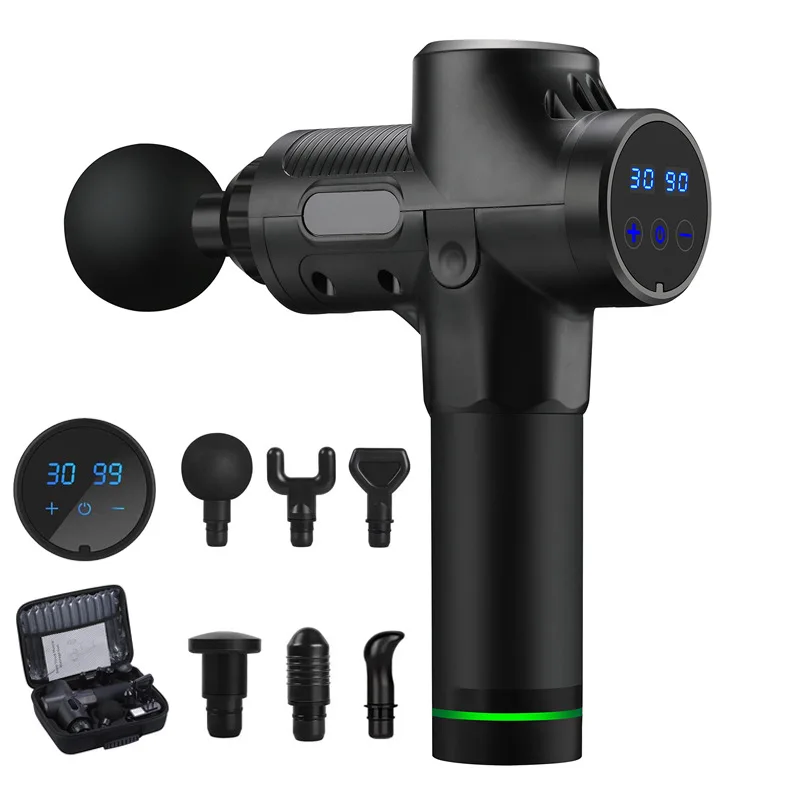
The large-screen long-stroke model is a strong choice for Germany, Nordic countries, and Poland when buyers need a premium-looking OEM massage gun with stronger specifications. Typical EXW pricing is $14–20, MOQ is around 300 units.
Dive Deeper: Why Long Stroke Drives Premium Positioning
The large-screen high-configuration model targets a different buyer group. It fits users who compare specifications carefully. German and Nordic consumers often read product details, reviews, and comparison tables before purchasing.[^4] They may ask about amplitude, motor power, stall force, noise, and battery life.
This is why 12–14 mm amplitude[^5] matters. In many fitness communities, 12 mm or above is seen as a more serious massage gun range. Some premium brands promote 12–16 mm amplitude as a professional standard. I do not suggest copying those claims blindly, but I do suggest buyers understand why the number influences customer perception.
Typical Large-Screen Model Specifications
| Item | Common Specification |
|---|---|
| Amplitude | 12–14 mm |
| Motor | High-power brushless motor |
| Display | Large LCD touch screen |
| Speed levels | Around 30 levels |
| Battery | 2500mAh |
| Working time | 6–8 hours |
| Massage heads | 6–12 professional heads |
| Main markets | Germany, Sweden, Norway, Denmark, Poland |
The large LCD display helps the product look premium. It also gives the seller stronger visual content for Amazon images, trade fair samples, and independent-store landing pages. However, I would not rely only on appearance. A premium product must pass stricter inspection.
Quality Control Points I Recommend
For this model, I usually focus on:
-
Heavy-pressure stall test
The motor should not stop too easily under normal use. A weak motor creates bad reviews. -
Noise under load
Some massage guns sound quiet in the air but become loud when pressed against the body. -
Heat buildup
A long session can expose poor internal structure or weak motor design. -
Battery runtime test
Buyers should test runtime at medium and high speeds, not only low speed. -
Button and screen reliability
Touch screens look good, but they must remain responsive after repeated use. -
Accessory quality
Massage heads should fit tightly. Loose heads make the product feel cheap.
This model is best for boutique Amazon sellers, physiotherapy-related retail channels, and higher-end fitness brands. However, buyers should avoid making medical treatment claims unless they receive professional guidance and comply with local rules. A massage gun can be marketed as a recovery, relaxation, or muscle-care tool, but medical claims need caution.[^6]
From CHALKART’s business context, I have seen that European buyers often ask for stable certification packages such as CE, RoHS, LVD, and RED when wireless functions are involved. I always suggest buyers verify certificates against the actual model number, factory name, test standard, and issuing lab. A certificate is useful only when it matches the product being shipped.
Should Buyers Consider a Heating and Cooling OEM Massage Gun for Home Wellness?
The traditional massage gun category has strong price pressure. Many sellers feel stuck because every competitor looks similar. A heating and cooling model gives a new angle. It adds home wellness value and attracts users beyond the fitness crowd.
A heating and cooling OEM massage gun is worth considering for home wellness channels because it combines vibration, heat, and cold functions in one product. Typical EXW pricing is $15–23, MOQ is around 500 units.

Dive Deeper: How This New Category Changes the Sales Story
The heating and cooling 2-in-1 model is one of the fastest-growing innovation directions I see in the category. The main reason is simple: it creates a new reason to buy. A standard massage gun only competes on motor power, amplitude, noise, battery, and price. A heating-cooling model adds functional differentiation.
In market observations for 2025–2026 planning, this category shows strong growth potential, especially in home wellness channels. Some suppliers report year-on-year export order growth around 57% for this type of product. I treat that figure as a supplier-side market signal, not as official customs data. Buyers should always validate demand with their own sales channels.
Typical Heating-Cooling Model Specifications
| Item | Common Specification |
|---|---|
| MOQ | Around 500 units |
| Amplitude | 6–10 mm |
| Motor | Often brushed motor in some versions |
| Special function | Heating and cooling massage heads |
| Heating speed | About 4–5 seconds in common supplier claims |
| Functions | Vibration, heat therapy, cold application |
| Battery | Around 1800mAh |
| Accessories | 4 vibration heads + 1 heating head + 1 cooling head |
| Main markets | UK, Germany, France |
This model expands the target customer group. A normal high-power massage gun often targets gym users and sports recovery buyers. A heating-cooling massage gun can also attract home users, older consumers, office workers, and people who want simple relaxation after work.
Where the Product Can Win
I see three clear advantages:
-
It avoids pure price competition.
The function is easier to explain than small technical differences. -
It supports stronger content marketing.
Sellers can show use scenes for shoulder relaxation, leg care, office fatigue, and home wellness. -
It feels new in a mature category.
Many basic massage guns look the same, so innovation helps listing conversion.
Where Buyers Must Be Careful
This product also needs more careful inspection than a standard model. Heating and cooling functions add parts, wiring, temperature control, and safety questions. Buyers should request sample testing before mass order.
I recommend checking:
-
Temperature range and stability
The hot and cold head should perform consistently. The supplier should state temperature limits clearly. -
Surface safety
The heating head should not become unsafe for skin contact. Buyers should request test reports and conduct their own checks. -
Battery load
Heating and cooling functions may consume more power than vibration alone. -
User manual clarity
The manual should explain safe use time, charging, cleaning, and warnings. -
Compliance documentation
Buyers should verify CE, RoHS, LVD, battery files, and any relevant local requirements.
I would choose this model when a buyer wants novelty, better listing differentiation, and a broader home-use audience. I would not choose it only because it is trendy. The supplier must show stable production, clear testing, and responsible after-sales support.
Frequently Asked Questions
What is the best OEM massage gun for a first European order?
The K1 standard model is usually the safest first order because it has mature production, broad market acceptance, and a lower FOB price. I would still test samples, verify certificates, and compare at least two supplier quotations before confirming mass production.
What MOQ should I expect for China OEM massage gun orders?
MOQ depends on the model and customization level. Basic models often start around 300–500 units. Mini gift models may start around 1,000 units. Logo printing is easier than custom mold development, so I suggest starting with light customization first.
Which certifications should European buyers verify?
European buyers commonly check CE, RoHS, LVD, RED if wireless functions apply, plus battery documents such as UN38.3 and MSDS. I recommend verifying that each certificate matches the exact model, factory, standard, and shipment version.
Is a mini massage gun powerful enough for fitness users?
A mini massage gun is usually better for light relaxation, travel, and gifting. It is not the best choice for serious deep-tissue sports recovery. Fitness users normally prefer a larger brushless motor model with at least 12 mm amplitude.
How can I reduce after-sales risk when importing massage guns?
I reduce risk by testing samples, checking real amplitude, confirming motor supplier, reviewing battery files, inspecting packaging, and agreeing on replacement terms before payment. I also prefer suppliers with stable export experience and clear communication.
Conclusion
An OEM massage gun is still one of the most practical product options for European cross-border sellers, gift traders, fitness brands, and wellness retailers. The right model depends on your channel: K1 for volume, B37-OEM for mid-range differentiation, KH-320 Mini for gifts, large-screen long-stroke models for premium fitness buyers, and heating-cooling models for home wellness growth. If you want flexible MOQ, OEM support, and stable after-sales cooperation, I invite you to contact CHALKART and compare a sample plan for your market.
[^1]: "The impact of online reviews in the presence of customer returns", https://pmc.ncbi.nlm.nih.gov/articles/PMC7501828/. A study of online consumer reviews and product performance supports the general relationship between product quality signals, review outcomes, and sales performance; it does not prove that any specific massage gun model will create slow sales or after-sales pressure. Evidence role: general_support; source type: paper. Supports: The source should support that product quality, customer satisfaction, and online review valence can influence sales outcomes and post-purchase issues.. Scope note: Contextual support only; the source would not directly evaluate the OEM massage gun models discussed in the article. [^2]: "The natural angle between the hand and handle and ...", https://pubmed.ncbi.nlm.nih.gov/23510164/. Human-factors research on handle geometry shows that tool-handle angle can influence wrist deviation and upper-limb posture, supporting the ergonomic rationale for an angled massage-gun handle. Evidence role: mechanism; source type: paper. Supports: The source should support that handle angle and tool geometry can affect wrist deviation and ergonomic comfort.. Scope note: The evidence is likely based on tool ergonomics generally, not on this specific B37-OEM massage gun. [^3]: "The European Medical Device Regulation–What Biomedical ...", https://pmc.ncbi.nlm.nih.gov/articles/PMC9395138/. European medical-device guidance explains that a product's stated intended purpose and claims can determine regulatory status, supporting the need for compliance review before making medical-related massage-gun claims. Evidence role: general_support; source type: government. Supports: The source should support that intended purpose and claims can affect whether a product falls under medical-device regulation in the EU.. [^4]: "Eurobarometer 65.1: The Future of Europe, Transborder ...", https://www.icpsr.umich.edu/web/ICPSR/studies/20321. European consumer survey data show that online product information, reviews, and comparison tools are used in purchase decisions, providing contextual support for the article's statement about information-oriented buyers. Evidence role: general_support; source type: government. Supports: The source should support that European consumers use online reviews, product information, or comparison tools during purchase decisions.. Scope note: The source may report European or country-level online-shopping behavior rather than massage-gun-specific behavior. [^5]: "The Effect Of Percussive Therapy On Musculoskeletal ... - PMC", https://pmc.ncbi.nlm.nih.gov/articles/PMC10069390/. Research describing percussive or vibration therapy devices identifies amplitude or displacement as a device parameter, supporting the use of stroke depth as a technical specification in massage-gun comparisons. Evidence role: definition; source type: paper. Supports: The source should support that amplitude or stroke depth is a recognized parameter in percussive massage or vibration therapy devices.. Scope note: The source may define amplitude as a relevant parameter without establishing that 12–14 mm is superior for all users. [^6]: "The European Medical Device Regulation–What Biomedical ...", https://pmc.ncbi.nlm.nih.gov/articles/PMC9395138/. EU medical-device guidance states that intended purpose and claims are central to product qualification, supporting caution when moving from wellness language to medical treatment claims. Evidence role: general_support; source type: government. Supports: The source should support that medical claims and intended medical purpose are relevant to medical-device qualification in the EU..


